Modeling Saudi Nominal GDP Sensitivity to Oil Shocks نمذجة حساسية الناتج المحلي السعودي لصدمات النفط
Despite diversification efforts, oil revenues remain the primary liquidity driver for the Saudi economy. This project moves beyond simple correlation matrices to quantify the dynamic elasticity of the national economy to oil price shocks. Using an Autoregressive Distributed Lag (ARDL) framework, I modeled the impact of nominal Arab Light spot prices on Nominal GDP (Current Prices).
رغم جهود التنويع الاقتصادي، تظل الإيرادات النفطية المحرك الرئيسي للسيولة في الاقتصاد السعودي. يتجاوز هذا المشروع مصفوفات الارتباط البسيطة لقياس المرونة الديناميكية للاقتصاد الوطني تجاه صدمات أسعار النفط. باستخدام إطار الانحدار الذاتي للفجوات المبطئة (ARDL)، قمت بنمذجة تأثير الأسعار الفورية الاسمية للخام العربي الخفيف على الناتج المحلي الإجمالي الاسمي (بالأسعار الجارية).
Note: This model uses nominal variables to capture the full pass-through of oil windfalls, including price effects and inflationary transmission, rather than real output growth alone.
ملاحظة: يستخدم هذا النموذج متغيرات اسمية لرصد الانتقال الكامل لعوائد النفط، بما في ذلك تأثيرات الأسعار والانتقال التضخمي، بدلاً من نمو الناتج الحقيقي فقط.
Methodological Justification: Why ARDL? التبرير المنهجي: لماذا ARDL؟
Standard Ordinary Least Squares (OLS) regression can be problematic in time series analysis without rigorous pre-testing. The Autoregressive Distributed Lag (ARDL) model was selected to address three specific econometric challenges:
قد يكون انحدار المربعات الصغرى العادية (OLS) إشكالياً في تحليل السلاسل الزمنية دون اختبارات دقيقة. تم اختيار نموذج (ARDL) لمعالجة ثلاثة تحديات قياسية محددة:
1. The Problem of Stationarity 1. مشكلة السكون (Stationarity)
- OLS Limitation: OLS on non-stationary series (I(1)) can yield spurious regression results unless cointegration is strictly proven. Saudi GDP and Oil Prices typically exhibit non-stationary trends.
- ARDL Solution: ARDL provides a unified framework to test and estimate long-run relationships regardless of whether variables are purely I(0), I(1), or mixed (provided none are I(2)).
- قيد OLS: تطبيق OLS على سلاسل غير ساكنة (I(1)) قد يؤدي إلى نتائج انحدار زائفة (Spurious Regression). تظهر بيانات الناتج المحلي وأسعار النفط عادة اتجاهات غير ساكنة.
- حل ARDL: يوفر إطاراً موحداً لاختبار وتقدير العلاقات طويلة الأجل بغض النظر عما إذا كانت المتغيرات ساكنة I(0) أو غير ساكنة I(1) أو مختلطة (بشرط ألا تكون I(2)).
2. Dynamic vs. Static Modeling 2. النمذجة الديناميكية مقابل الساكنة
OLS is often a static specification. ARDL is explicitly dynamic; it captures the "inertia" of the economy by including lagged values of both GDP and Oil Prices, acknowledging that economic shocks take time to filter through the system.
غالباً ما يكون OLS نموذجاً ساكناً. بينما ARDL ديناميكي صراحةً؛ فهو يلتقط "القصور الذاتي" للاقتصاد من خلال تضمين قيم مبطئة (Lags) لكل من الناتج المحلي وأسعار النفط، معترفاً بأن الصدمات الاقتصادية تستغرق وقتاً لتنتقل عبر النظام.
3. Endogeneity Concerns 3. مخاوف التداخل الداخلي (Endogeneity)
By including lags of the dependent and independent variables, the ARDL specification helps reduce dynamic endogeneity concerns, though it does not claim to fully identify causal mechanisms.
من خلال تضمين فجوات للمتغيرات التابعة والمستقلة، تساعد مواصفات ARDL في تقليل مخاوف التداخل الداخلي الديناميكي، وإن كانت لا تدعي تحديد الآليات السببية بشكل كامل.
| Featureالميزة | Standard OLSمربعات صغرى عادية (OLS) | ARDL Approachمنهجية ARDL |
|---|---|---|
| Data Integrationتكامل البيانات | Requires variables to be stationary I(0).تتطلب أن تكون المتغيرات ساكنة I(0). | Handles mixed I(0) and I(1) variables.تتعامل مع متغيرات مختلطة I(0) و I(1). |
| Long-Run Relationshipالعلاقة طويلة الأجل | Risk of spurious regression if non-stationary.خطر الانحدار الزائف إذا كانت البيانات غير ساكنة. | Uses Bounds Test to validate cointegration.تستخدم اختبار الحدود للتحقق من التكامل المشترك. |
Dynamic Multiplier Analysis تحليل المضاعف الديناميكي
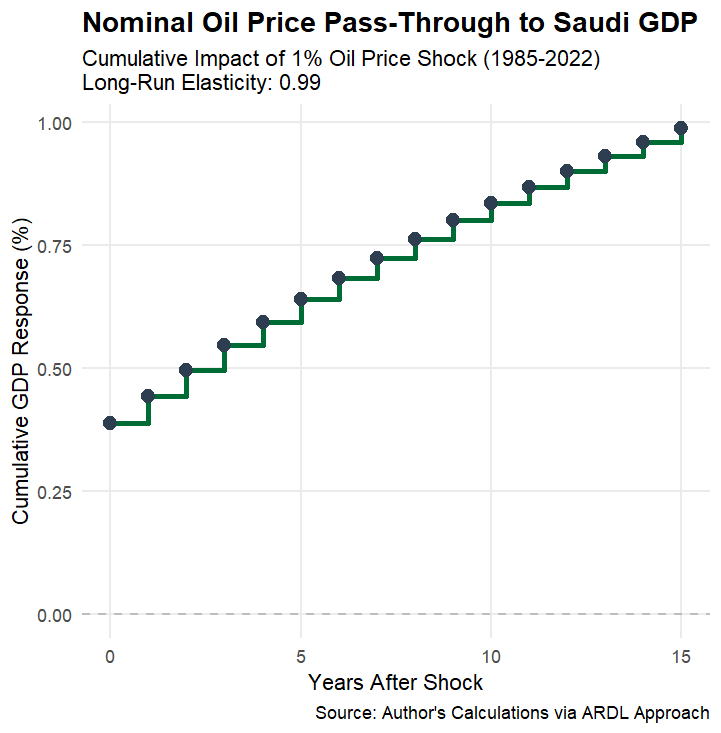
The chart below illustrates the nominal pass-through of oil shocks into the Saudi economy over a 15-year horizon:
يوضح الرسم البياني أدناه الانتقال الاسمي لصدمات النفط إلى الاقتصاد السعودي على مدى 15 عاماً:
Interpretation التفسير
- Immediate Impact (T=0): A 0.39% increase, likely reflecting direct revenue recognition in the state budget and immediate sentiment effects.
- The Transmission (T=1 to T=5): The curve continues to rise, consistent with a fiscal transmission mechanism documented in the literature, whereby oil revenues are recycled through government spending, wages, and corporate contracts.
- Long-Run Equilibrium: Stabilizes at 1.51%, suggesting a high sensitivity of the nominal economy to oil price levels.
- الأثر الفوري (T=0): زيادة بنسبة 0.39%، تعكس غالباً تسجيل الإيرادات المباشرة في الميزانية وتأثيرات الثقة الفورية.
- آلية الانتقال (T=1 إلى T=5): يستمر المنحنى في الصعود، بما يتسق مع آلية الانتقال المالي الموثقة، حيث يتم إعادة تدوير عوائد النفط عبر الإنفاق الحكومي، والأجور، والعقود.
- توازن المدى الطويل: يستقر عند 1.51%، مما يشير إلى حساسية عالية للاقتصاد الاسمي تجاه مستويات أسعار النفط.
Model Specification مواصفات النموذج
The analysis uses 38 years of annual data (1985–2022) from SAMA & World Bank. A Log-Log transformation was applied to interpret coefficients as elasticities.
يعتمد التحليل على بيانات سنوية لـ 38 عاماً (1985–2022) من البنك المركزي والبنك الدولي. تم تطبيق التحويل اللوغاريتمي لتفسير المعاملات كمرونات (Elasticities).
Implied Long-Run Equilibrium Relationship: علاقة التوازن طويلة الأجل الضمنية:
The auto_ardl algorithm selected an ARDL(1,1) structure based on AIC (-106.88). The long-run elasticity is derived from the estimated short-run coefficients:
اختارت خوارزمية auto_ardl هيكلية ARDL(1,1) بناءً على معيار AIC. تم اشتقاق المرونة طويلة الأجل من المعاملات قصيرة الأجل المقدرة:
Robustness & Diagnostic Checks فحوصات المتانة والتشخيص
To ensure the validity of the results, the model underwent a rigorous battery of diagnostic tests. The results confirm that the model is statistically sound and the estimated relationships are not artifacts of bias.
لضمان صحة النتائج، خضع النموذج لمجموعة صارمة من الاختبارات التشخيصية. تؤكد النتائج أن النموذج سليم إحصائياً وأن العلاقات المقدرة ليست نتاجاً للتحيز.
Diagnostic Test Definitions تعريفات الاختبارات التشخيصية
| Diagnostic Testالاختبار التشخيصي | Metric / H0المقياس / الفرضية الصفرية | Resultالنتيجة | Conclusionالاستنتاج |
|---|---|---|---|
| Bounds Test | F-Stat = 14.99 | F > I1 Upper Bound | Pass (Cointegration) |
| Breusch-Godfrey | p = 0.567 | Cannot reject H0 | Pass (No Autocorrelation) |
| Breusch-Pagan | p = 0.360 | Cannot reject H0 | Pass (Homoscedastic) |
| Shapiro-Wilk | p = 0.133 | Cannot reject H0 | Pass (Normal Errors) |
| Ramsey RESET | p = 0.150 | Cannot reject H0 | Pass (Correct Form) |
Parameter Stability استقرار المعاملات
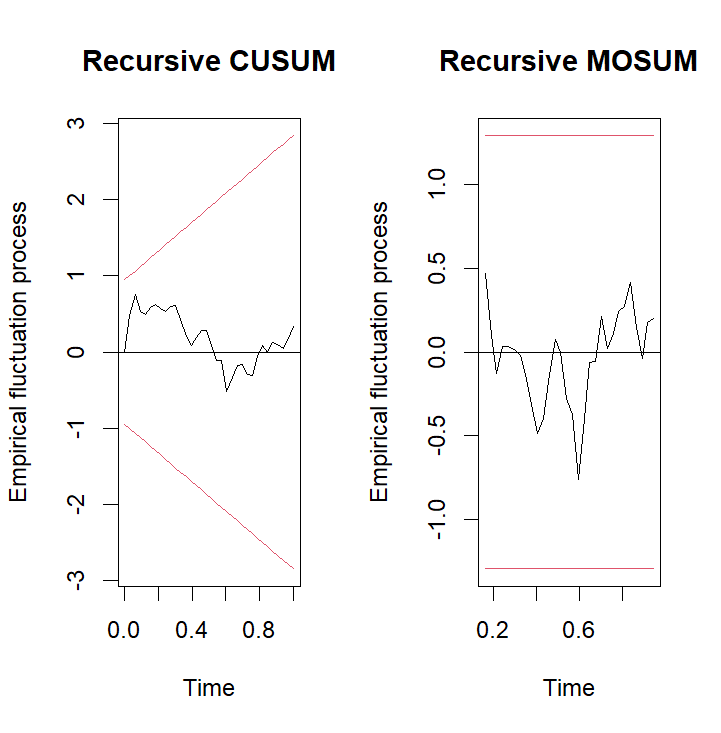
Structural stability was tested using the Recursive CUSUM test. As shown below, the plot line remains within the 5% critical bounds, indicating no evidence of parameter instability.
تم اختبار الاستقرار الهيكلي باستخدام اختبار CUSUM التكراري. كما هو موضح أدناه، يظل الخط البياني داخل حدود الـ 5% الحرجة، مما يشير إلى عدم وجود عدم استقرار في المعاملات.
Study Limitations حدود الدراسة
- Nominal vs. Real: The model uses nominal variables. Results reflect wealth transmission rather than pure real output growth.
- Sample Size: Analysis is limited to 38 annual observations (1985–2022).
- Omitted Variables: The model focuses on the direct Oil-GDP nexus and does not explicitly model fiscal channels.
- الاسمي مقابل الحقيقي: يستخدم النموذج متغيرات اسمية. تعكس النتائج انتقال الثروة بدلاً من نمو الناتج الحقيقي الصرف.
- حجم العينة: يقتصر التحليل على 38 مشاهدة سنوية (1985–2022).
- المتغيرات المحذوفة: يركز النموذج على الرابط المباشر بين النفط والناتج ولا ينمذج القنوات المالية صراحة.
Conclusion: Oil Prices as a Nominal Repricing Mechanism الخلاصة: أسعار النفط كآلية إعادة تسعير اسمية
This study quantifies a structurally large long-run elasticity (1.51) between nominal oil prices and Saudi nominal GDP, confirming that oil price movements operate less as a cyclical growth driver and more as a system-wide nominal repricing mechanism. The magnitude of this elasticity implies that changes in oil prices propagate through the economy primarily via valuation effects — export receipts, fiscal revenues, and government expenditure — rather than through contemporaneous increases in real productive capacity.
تحدد هذه الدراسة مرونة طويلة الأجل كبيرة هيكلياً (1.51) بين أسعار النفط الاسمية والناتج المحلي الإجمالي السعودي الاسمي، مما يؤكد أن تحركات أسعار النفط تعمل كآلية إعادة تسعير اسمية شاملة للنظام أكثر من كونها محركاً دورياً للنمو. يشير حجم هذه المرونة إلى أن تغيرات الأسعار تنتقل عبر الاقتصاد بشكل أساسي من خلال تأثيرات التقييم — عوائد الصادرات، والإيرادات المالية، والإنفاق الحكومي — بدلاً من الزيادات الفورية في القدرة الإنتاجية الحقيقية.
The dynamic multiplier path reinforces this interpretation. The gradual accumulation of the response over multiple years is consistent with a fiscal recycling channel, where oil windfalls are absorbed into the economy through public spending, wages, and contracts, inflating nominal aggregates even in the absence of proportional real output expansion. In this sense, headline nominal GDP growth during oil upswings should be interpreted as a balance-sheet and price-level phenomenon, not evidence of endogenous productivity gains.
يعزز مسار المضاعف الديناميكي هذا التفسير. يتسق التراكم التدريجي للاستجابة مع قناة التدوير المالي، حيث يتم استيعاب الفوائض النفطية عبر الإنفاق العام والأجور والعقود، مما يضخم المجاميع الاسمية حتى في غياب توسع حقيقي متناسب في الناتج. بهذا المعنى، يجب تفسير نمو الناتج المحلي الاسمي أثناء طفرات النفط كظاهرة ميزانية ومستويات أسعار، وليس كدليل على مكاسب إنتاجية داخلية.
Analytical and Policy Implications الآثار التحليلية والسياساتية
For applied analysts, the estimated elasticity functions as a diagnostic filter. A coefficient exceeding unity signals that nominal GDP growth is disproportionately driven by oil price movements. Without explicit deflation or decomposition, periods of strong nominal expansion may overstate underlying economic momentum.
بالنسبة للمحللين، تعمل المرونة المقدرة كمرشح تشخيصي. يشير المعامل الذي يتجاوز الواحد الصحيح إلى أن النمو الاسمي مدفوع بشكل غير متناسب بتحركات أسعار النفط. وبدون تعديل أو تفكيك للبيانات، قد تبالغ فترات التوسع الاسمي القوي في تصوير الزخم الاقتصادي الأساسي.
From a structural perspective, genuine economic diversification would manifest not as higher average growth rates, but as a persistent decline in this elasticity over time. A weakening oil–GDP elasticity would indicate that non-oil private sector activity, investment, and productivity are increasingly decoupled from fiscal oil revenue recycling.
من منظور هيكلي، لن يظهر التنويع الاقتصادي الحقيقي كمعدلات نمو أعلى، بل كانخفاض مستمر في هذه المرونة بمرور الوقت. سيشير ضعف مرونة النفط-الناتج إلى أن نشاط القطاع الخاص غير النفطي والاستثمار والإنتاجية أصبحوا منفصلين بشكل متزايد عن إعادة تدوير الإيرادات النفطية الحكومية.
Selected References & Data Sources المراجع ومصادر البيانات المختارة
- Elhassan, T. (2021). Impact of Oil Price Fluctuations on Economic Growth in Saudi Arabia: Evidence from a Nonlinear ARDL Approach. International Journal of Energy Economics and Policy, 11(5), 579–585.
- The World Bank. (2023). World Development Indicators: GDP (current US$). Washington, D.C.
- Saudi Central Bank (SAMA). (2023). Yearly Statistics: Energy & Oil Prices. Riyadh, Saudi Arabia.